
Publication date:
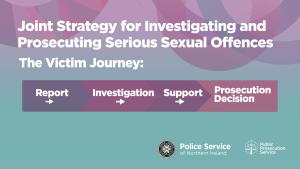
Five-year Strategy places victims at the centre of a shared commitment to improve support, reduce delay and strengthen accountability across the criminal justice system.
The Police Service of Northern Ireland (PSNI) and the Public Prosecution Service for Northern Ireland (PPS) today launched a new five-year Joint Strategy for Investigating and Prosecuting Serious Sexual Offences, setting out a shared commitment to improve the experience of victims and strengthen the criminal justice response to some of the most serious crimes in society.
The Strategy is the first of its kind developed jointly by the two organisations and has been informed by engagement with statutory partners, voluntary organisations and those with lived experience. It establishes a framework for closer collaboration between investigators and prosecutors while recognising the distinct and independent roles of both organisations.
At the heart of the strategy are two clear ambitions:
- To ensure that no victim withdraws from the criminal justice process because of their experience of the investigation or prosecution process.
- To reduce the time taken to investigate and reach prosecution decisions in serious sexual offence cases by one third over the lifetime of the Strategy.
To this end, the strategy is built around four key outcomes:
- Improving support to victims with trauma-sensitive support to meet their needs, including clear communication.
- Improving timeliness and quality to progress cases as quickly as possible, whilst prioritising exceptional case file quality.
- Demonstrating accountability and leadership to encourage reporting to police, and help influence both the prevention and detection of these crimes.
- Further development for specialist investigators and prosecutors.
The current median time from initial police report to a prosecution decision is 224 days. The PSNI and PPS have today set out a joint ambition to reduce this by 75 days (around one third).
A detailed two-year Action Plan has been agreed which sets out key outcomes and how they will be delivered. Implementation has already begun and progress will be monitored through annual reporting against agreed performance measures.
The Head of the Police Service of Northern Ireland’s Public Protection Branch, Detective Chief Superintendent Zoe McKee said: “Every report of a serious sexual offence represents a person who has placed their trust in us at what may be one of the most difficult moments of their life. That trust carries a profound responsibility.
“We know that victims expect investigations that are thorough, compassionate and as timely as possible. We also recognise that the criminal justice process can sometimes add to the trauma experienced by victims, particularly where cases become protracted.
“This Strategy reflects our determination to improve. It has been shaped by listening carefully to victims, partner organisations and our own staff, and by recognising that meaningful change requires sustained partnership across policing and prosecution.
“We are making clear commitments that the public can judge us against. By working even more closely with the Public Prosecution Service we want to improve communication with victims, reduce avoidable delay and strengthen the quality of investigations while maintaining the highest professional standards.
“Most importantly, we want every victim to know that they will be treated with dignity, professionalism and respect throughout the criminal justice process.”
PPS Senior Assistant Director and Victim Champion Marianne O’Kane said: “Victims are at the heart of this Strategy. We know that the decision to report a sexual offence takes immense courage, and we want every victim to feel supported, informed and treated with empathy throughout the prosecution process.
“For many victims, their experience of the criminal justice system can be just as important as the outcome of a case. That is why the PPS is committed to improving communication, offering greater support and ensuring that victims understand what is happening in their case and why.
“A key ambition of this Strategy is that no victim withdraws support for a case because of their experience of the investigation or prosecution process. We also want to reduce by one third the time it takes to investigate these offences and reach a prosecution decision, helping to minimise the additional trauma that delay can cause.
“By working closely with the PSNI, victim support organisations and partners across the justice system, we have an opportunity to make meaningful improvements for victims that strengthen confidence and deliver a better experience for every victim at each stage of their journey. However, achieving these ambitions will require sustained investment across the criminal justice system to ensure specialist teams have the resources needed to deliver the change victims deserve.”
Nicola Bannon, now 61 years of age, was abused by a teacher when she was a teenager. William Lloyd Lavery was sentenced on the 28th April this year to two years' imprisonment for six counts of indecent assault of a child. From 1976-1978, Lavery sexually assaulted four girls, all aged around 13 years old.
Now Nicola is speaking out in support of the PSNI and PPS’s strategy to strengthen further the criminal justice journey for victims like herself and encourage more people to report sexual crimes against them.
She says: “My loss of innocence at the hands of a trusted teacher, nearly half a century ago, is a trauma that will live with me to the end of my days. I have been left with a near-video-perfect recall of my abuse. Silence is a prison with no bars, but speaking up is freedom and the path to justice.
“There has been a significant evolution in society's understanding of a victim's journey over the past few years, but I appreciate the recognition from this new strategy that more can and should be done.
“I was fortunate that my case came at a time when a new Special Measure for victims and witnesses was being introduced, the use of Remote Evidence Centres. My successful application to the court for this measure was supported and handled by the PPS.
“It was a huge relief to be able to give a pre-recorded interview to my dedicated PSNI case manager. That interview was later played in court, meaning I did not have to give my evidence live from the witness box. During the trial, I was then cross-examined by Video-Link in a remote room with my nominated Victim Support NI companion at my side throughout. My abuser was not visible to me from the dock when I was giving my evidence remotely, which allowed me to give my very best evidence to the court. These are the things that mean so much to victims and are the reasons why we stay in the system to get justice and accountability.
“The relief I have experienced in speaking out has been well worth it. I feel a genuine acceptance about the abuse that I endured and an inner calm I never had before. The profound sense of injustice that I have carried for nearly five decades has now been lifted and replaced with a renewed drive to live my life to the full, unencumbered by the past.”
The Joint Strategy covers the period 2026–2031 and includes a detailed action plan for the first two years of implementation.
Progress will be overseen through a new governance structure, including a Sexual Violence and Abuse Strategic Oversight Board and an Independent Consultation Group, with annual reporting to demonstrate delivery against agreed outcomes.
The full Strategy is available at:
ENDS
Notes to Editors
About the Strategy
The Joint Strategy for Investigating and Prosecuting Serious Sexual Offences has been developed by the Police Service of Northern Ireland and the Public Prosecution Service.
It covers the period 2026–2031 and sets out a shared framework for improving the investigation and prosecution of serious sexual offences.
Two Strategic Ambitions
- No victim should withdraw from the criminal justice process because of their experience of investigation or prosecution.
- Reduce investigation and prosecution decision times by one third over the lifetime of the Strategy.
Four Strategic Outcomes
- Improved support to victims.
- Improving timeliness and quality.
- Demonstrating accountability and leadership.
- Developing specialist staff.
Governance
Delivery will be monitored through:
- Sexual Violence and Abuse Strategic Oversight Board.
- Outcomes Delivery Group.
- Independent Consultation Group.
Progress will be reported publicly each year.